
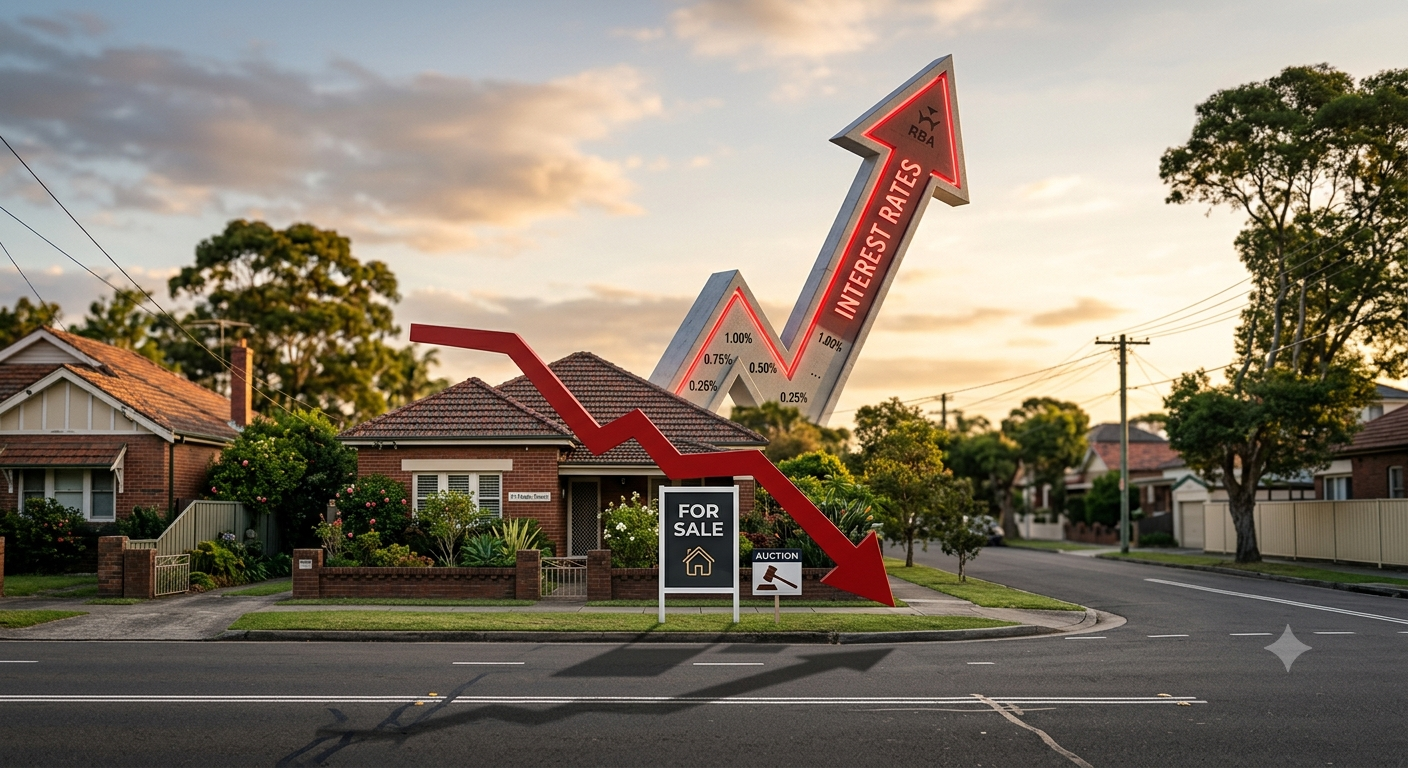
The Reserve Bank of Australia (RBA) has increased the official cash rate by 0.25 percentage points, taking it from 4.35% to 4.60%. This is the fourth interest rate increase in 2026 and takes the cash rate to its highest level since 2011.
The latest increase comes at a time when property prices are already declining across much of Australia. For homeowners and prospective buyers, the combination of higher borrowing costs and softer property values is likely to remain an important consideration.
What does the rate increase mean for mortgage holders?
The immediate impact will depend on how much of the increase banks and other lenders pass on to customers with variable-rate loans.
As an indication, a full 0.25 percentage point increase could add around $91 a month to repayments on a $600,000 mortgage with 25 years remaining. Across the four rate increases made this year, the same borrower could now be paying roughly $364 more each month than before the increases began.
The actual increase will vary depending on the loan balance, interest rate, remaining loan term and how individual lenders respond.
For borrowers, this means reviewing current loan repayments and checking whether the household budget can comfortably manage higher costs.
Property prices are falling across many markets
The latest rate increase comes as Australia’s housing market continues to weaken.
According to Cotality data reported by Homely, national home values fell by 0.9% in August. This was the fifth consecutive monthly decline and left property values 3.6% below their March peak. During winter, values fell across 93% of capital-city suburbs.
The decline has not been the same everywhere.
Sydney recorded the largest monthly fall among the capital cities, with values dropping 1.4% in August. Melbourne and Canberra both fell 1.1%, while Brisbane declined 1.0%. Adelaide and Perth recorded falls of 0.8%.
Regional property markets also weakened, although the decline was smaller, at 0.4% over the month.
The higher-priced part of the market has experienced some of the largest falls. Upper-quartile house values in Sydney were 10.7% below their peak, while Melbourne’s were 10.5% below their peak.
Lower-priced homes and units have generally performed better, although these parts of the market are also showing signs of weakening.
Buyers have more choice, but borrowing is more expensive
Falling property prices can create more opportunities for buyers, particularly when sellers have more competition and properties remain on the market for longer.
The median time taken to sell a property increased from 28 days a year earlier to 39 days. The median vendor discount across the capital cities reached 4.2%, while the four-week average auction clearance rate was 49.5% at the end of August. Home sales over the latest quarter were estimated to be 15.5% lower than the same period a year earlier.
This may give some buyers greater room to negotiate.
However, a lower property price does not necessarily mean a property is more affordable.
Higher interest rates can reduce the amount a buyer is able to borrow while also increasing repayments on an existing or new mortgage. Anyone relying on an older loan pre-approval should therefore review their borrowing capacity before making an offer.
Why is the RBA increasing rates while property prices are falling?
The RBA’s primary focus is inflation, rather than maintaining property prices.
Australia’s latest available inflation figures showed consumer prices were 3.5% higher in the year to July. Underlying inflation, measured using the trimmed mean, remained at 3.6%. Both figures are above the RBA’s preferred 2–3% inflation target range.
Several areas are continuing to put pressure on household costs. Housing costs increased 5.0% over the year to July, while the cost of new dwellings increased 5.7%. Food prices were 3.2% higher, and petrol prices rose 7.5% in July alone.
The RBA is also concerned that higher energy and other input costs could lead to further price increases if businesses pass their additional expenses on to customers.
Higher interest rates cannot directly reduce global oil prices or lower the cost of constructing homes. Instead, the RBA uses interest rates to influence spending and demand across the economy. The aim is to slow demand enough to reduce ongoing inflationary pressure.
What does this mean for the property market?
The latest rate increase highlights the difficult conditions facing Australia’s property market.
Higher borrowing costs are already affecting how much buyers can afford, while falling property values are putting additional pressure on sellers and homeowners.
At the same time, the RBA has recognised that a significant decline in housing activity could have wider effects on the economy. However, property prices remain substantially higher than they were at the beginning of 2020.
The next stage of the interest rate cycle remains uncertain. All four major Australian banks had expected the September increase, but their expectations for future movements differ. ANZ has forecast another increase in November, while the other major banks have identified the possibility of another increase as a risk.
For homeowners and buyers, the key issue will be how interest rates, inflation, borrowing costs and property prices develop over the coming months.
What should buyers and homeowners watch next?
Mortgage holders will be watching their lenders to see how they respond to the RBA’s latest decision.
The next inflation data will also be important because it will provide further information about whether price pressures are easing or remaining elevated. The RBA’s future decisions will depend on how inflation and the broader economy develop.
For buyers, the current environment may provide more negotiating opportunities, but affordability should be assessed carefully. For existing homeowners, higher repayments make it increasingly important to review loan costs and household finances.
The property market is being shaped by several factors at once, and interest rates are only one part of the picture. Local market conditions, employment, household finances, supply and buyer demand will also influence how individual property markets perform.